Dispatch 5: Critical Minerals + Critical Insights: Pivot to Strategy & Reboot ESG
April 2, 2025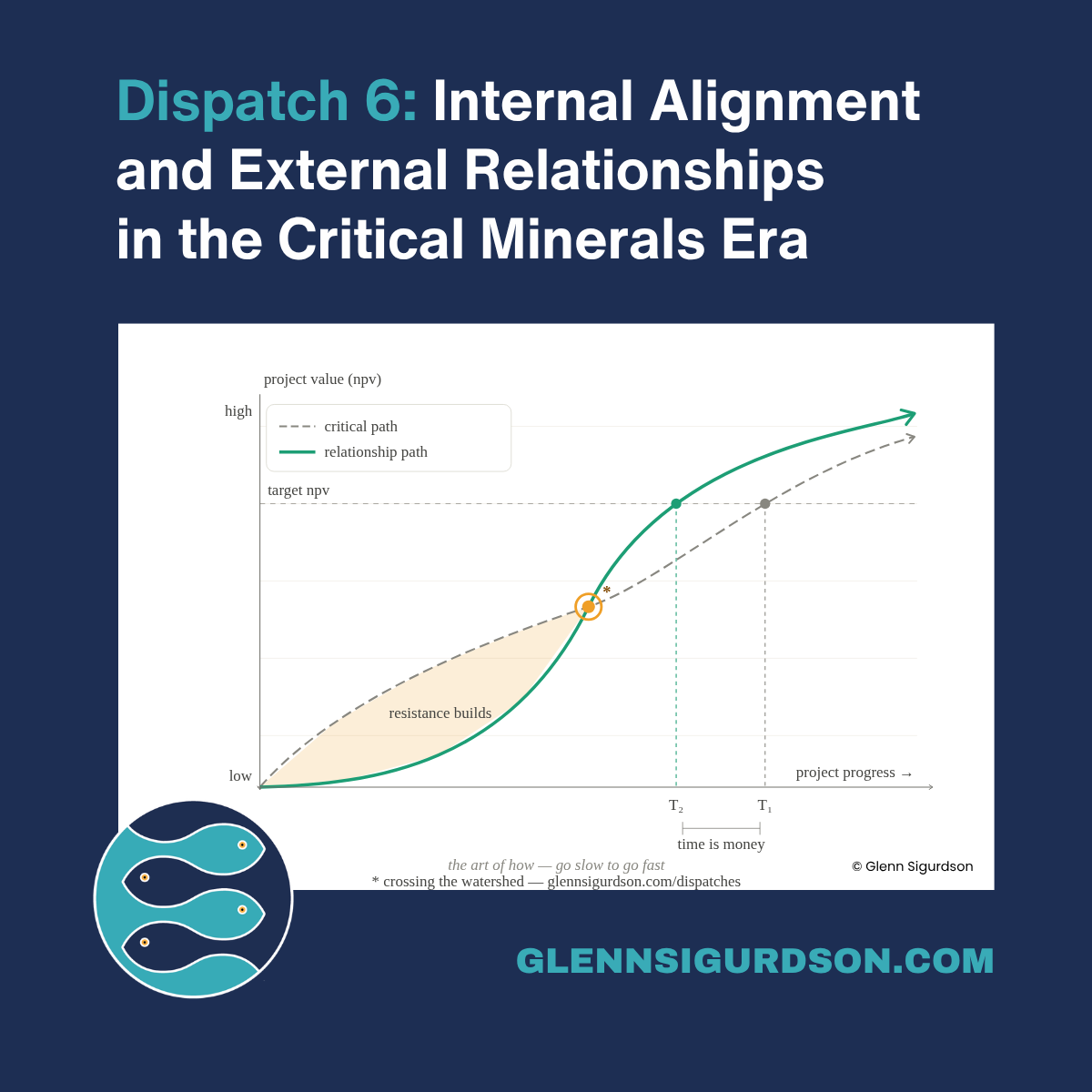
Mining the Past to Build the Future
Ground Zero: Where It Actually Happens
The starting point is always ground zero — the intersection where projects meet people, and where possibilities are turned into projects. Here, risk is managed and value is created or lost. This is the real action.
In 1998, a workshop in Lima brought together, for the first time, participants from across the Latin American mining sector alongside international voices to ask a foundational question: how do we build a sustainable future for the industry and the communities and regions in which it operates? That gathering was part of a trajectory running from the World Commission on Environment and Development through Canada’s Round Tables and on to the Global Mining Initiative and the Mining, Minerals and Sustainable Development project1 — a sequence of work that shaped the industry’s thinking for a generation.
The World Mining Congress returns to Lima in 2026. The questions are the same. The stakes are higher. What has changed — and what has not — is what this paper sets out to examine.
The Pressure of the Moment
This question is urgent now. Demand for critical and rare earth minerals is accelerating, driven by electrification, digitalization, and the global energy transition. Geopolitical realities are increasing the need for new supply sources. Governments and markets are pressing for speed — faster exploration, approvals, and production.
Yet mining remains a long-cycle industry operating in complex social and environmental settings. The faster we move, the more we risk outpacing our ability to manage relationships, expectations, and impacts. Speed without process does not accelerate development. It undermines the foundations on which development depends. The real challenge is not just to move faster, but to do so without destroying what speed depends upon.
Words are symbols, and the symbols we choose carry meaning we do not always control. “Fast-tracking” does not land the same way on both sides of a project boundary. To a company under market pressure, it signals efficiency. To a peasant farmer watching the water that sustains his already threatened fields being diverted to the mine on the adjacent hillside, it signals that the process will be compressed — that his concerns will receive less time and less attention. “Game changer” carries the same risk. For that farmer, it is a game changer, in the most direct and consequential sense. These are not neutral terms. The communities, Indigenous nations, and regions where resources are found do not experience urgency the way markets do. They experience it as pressure — pressure that has historically produced the worst outcomes in this industry. The critical minerals moment calls for a different response.
That response begins with understanding what “go slow to go fast” actually means in project development — because it is widely misunderstood. It is not a counsel of delay. It is a different model of how project trajectories work.
The conventional frame for managing a major project is a critical path — linear, sequential, time-driven. In that frame, the front end of a project is dead time: relationships to be managed, consultations to be completed, boxes to be checked before the real work begins. Every week spent at the front end is a week added to the schedule. Going slow costs time. Time costs money.
But that model is wrong — not as a matter of values, but as a matter of arithmetic. The zone between the engineer’s linear critical path and the community’s experience of how relationships develop is a point of tension — especially at the beginning. It is like the start of any major construction project: the first flashpoint is almost always the trucks. Speed and dust crossing into neighbouring territory generate irritation that, left unaddressed, becomes resistance. The friction that accumulates when front-end relationship work is skipped does not grow linearly. It compounds geometrically. A community relationship that was never properly built creates accelerating friction that stops projects, forces costly repairs, and in the worst cases — at Juukan Gorge in Western Australia, at Brumadinho in Brazil, and in the daily accumulation of smaller fractures across the industry — produces consequences that no schedule recovery can address.
Conversely, time invested at the front end does not merely delay the critical path — it changes its shape. The social ground is prepared. The relationships are in place before they are needed. When the hard moments come — and they always come — there is something to hold. The curve of the project bends. What looked like a slower start produces a faster, more stable overall trajectory, because the conditions that create resistance have been addressed before they became crises. This is what “go slow to go fast” actually means: not a compromise of the critical path, but a different and more accurate understanding of what the path is.
Start Inside to Work Outside
The proposition at the centre of this paper is this: internal coherence and external relationships must be understood and managed together. Each shapes the other. Organizations that focus on external engagement without addressing internal alignment find their efforts undercut by the structures they carry into the field. Organizations that focus on internal alignment without attending to the quality of their external relationships find that alignment has nothing to grip. The resource sector’s biggest risks and opportunities are not shaped by external forces alone. They are shaped by the interaction between how organizations function internally and how they engage externally — how decisions are made, how priorities are aligned, and how relationships are understood and managed across and beyond the organization.
This is not a new observation. It has been made before, in different ways, across the industry’s recent history. What is new is the cost of continuing to ignore it. Juukan Gorge. Brumadinho. The daily accumulation of smaller fractures that never make the news but quietly erode the foundations of what has been built. These are not failures of intention. They are failures of architecture.
The Art of How
At its core, this is a question of how decisions are made in the face of complexity, competing interests, and uncertainty. It is about how organizations and institutions navigate across differences — of values, rights, expectations, and power — while managing risk and pursuing opportunity.
It is about the way decisions are taken — the art of how, not simply the outcomes they produce. If we get the way right, we increase the likelihood of achieving durable, well-supported, and adaptable results over time. If we do not, even technically sound decisions can unravel in practice.
This is where sustainability enters — not as an abstract objective, but as a strategic lens. Once seen this way, sustainability is not an adjunct to strategy. It is strategy. It enables organizations to navigate complexity, manage risk, and identify opportunities to create value across different interests and different currencies of value. The goal is not sustainability in and of itself, but the development of successful projects and businesses that generate durable value for all parties.
The Limits of ESG and Linear Thinking
Over the past two decades, sustainable development has increasingly been translated into Environmental, Social, and Governance (ESG) frameworks. These frameworks have brought useful discipline and transparency, but they have also introduced complexity and, in some cases, distraction. As Helle Bank Jørgensen observed from Davos 2025, ESG needs less talk and more substance — investors want harder data, clearer impact, and a direct link between ESG, risk management, and business strategy.2 The diagnosis is right. But the response needs to go further: ESG does not need a reset so much as a reboot — reintegrated within a sustainable development lens, where it can serve as a tool rather than the toolbox.
Not all that matters can be measured, and an overemphasis on metrics can obscure what is most strategically important. ESG provides a useful rear-view mirror — it shows the road already travelled. What it does not provide is a navigation system for the road ahead.3 The problem is not ESG alone. Across the sector, there has been a proliferation of voluntary standards, reporting frameworks, certification schemes, and performance metrics of all kinds — each with its own logic, its own demands, and its own claim on organizational attention. Taken together, they reinforce a common tendency: to measure what is manageable rather than manage what is meaningful. The sector remains anchored in linear thinking, driven by organizational structures focused on discrete functions, metrics, and reporting silos. In the context of complex, integrated, multi-party challenges, these are not just limitations — they are risks.
The growing recognition of Indigenous rights and interests has permanently altered the balance of power in which the industry operates. As Indigenous Tahltan Elder Allen Edzerza put it directly: “It’s time to put the I into ESG!”4 That call reflects a deeper reality. UNDRIP and the principle of Free, Prior and Informed Consent have moved from aspiration to expectation. The pendulum has swung — from rights to reconciliation to respect — and it will not swing back. This change has not been fully absorbed into conventional organizational models or ESG frameworks. As a result, the challenges of alignment have intensified. Engaging effectively across different legal, cultural, and governance systems is no longer peripheral to project development. It is central to it.
Where Things Actually Break Down
A consistent pattern emerges across projects. External tensions often have internal causes — arising from misalignments within organizations. When community opposition or reputational risk surfaces, organizations too often look outward, missing that the root causes frequently lie within.
Different business areas — operations, procurement, corporate leadership, external affairs — pursue legitimate but uncoordinated objectives. This can result in decisions in one area causing unintended impacts in another. Whether we are looking at a risk not managed or an opportunity not realized: we have met the enemy, and it is us.5 If ESG and other performance measures do not include a robust means of assessing internal alignment and integration, this cornerstone strategic risk will lie hidden in wait — like the enemy within a Trojan horse.
The Juukan Gorge Disaster: Architecture, Not Malice
The consequences of these misalignments can be catastrophic. In May 2020, Rio Tinto blasted two ancient rock shelters at Juukan Gorge in Western Australia — destroying 46,000 years of continuous human occupation, sacred caves containing irreplaceable artefacts, and a living connection between a people and their country that no compensation could restore.
The blast was authorized under Section 18 of Western Australia’s Aboriginal Heritage Act — a statute dating from 1972, later described by a parliamentary inquiry as another means to destroy Indigenous heritage. In the company’s own framing, it was entirely legal. It intended to exercise its legal right regardless of opposition.
That framing did not hold. In an earlier era, legal authorization ended the conversation. Not anymore. The question that needed to be asked was not whether this could be done — it was what would happen when it was. The answer came swiftly: the CEO and two other senior executives lost their positions. A national and international outcry followed. A parliamentary inquiry was convened under the title “Never Again.” The reputational damage was severe and lasting. The law had permitted something that the world — including Rio Tinto’s own board — found intolerable. Legality and wisdom are not the same thing. In the critical minerals era, companies that confuse them do so at their peril.
The organizational analysis that followed, by Professor Deanna Kemp of the Centre for Social Responsibility in Mining at the University of Queensland and Professor Andrew Hopkins of the Australian National University, cut to the structural core:
Critical information about the deepening significance of the site had been in heritage assessments since 2013. It did not reach the people making operational decisions. The function responsible for Indigenous relations was peripheral to mine planning and production.
“Rio Tinto’s iron ore division was under extreme production pressure… It was authorised under West Australian law to mine the area, even though this would destroy the caves, and it intended to exercise this legal right, regardless of any opposition.”6
“Rio has a segmented organisational structure… When things go well, such an organisational structure is highly profitable. But there is a downside. It leaves the corporation vulnerable to poor decision making by any one of its product divisions, decisions that may have disastrous human and environmental consequences that threaten the social license of the whole corporation.”6
This was a cultural atrocity caused by organizational architecture, not malice. Every function performed its role. The structure failed.
The Granger Mine: How a Spark Reverberates
The same organizational diagnosis plays out daily at the operational level, often with less visibility but no less consequence. The following fictional case is grounded in the realities of project development across the industry.7
Roger, the mine manager at Granger Mine, had spent months working to rebuild a relationship with Gatzu’s community — the closest of four Indigenous communities along the Granger Valley. The relationship had frayed badly. For over a year the community had raised serious concerns about the volume of heavy trucks moving through their territory: clouds of dust, safety risks for children walking to school, a truck that had careened into the river. Then the dog of an elderly widow was struck by a speeding truck. The community erected a roadblock and shut the mine down for nearly a month.
Roger negotiated hard. The resolution came at a cost: a fuel supply agreement under which the mine would source all its fuel from the community’s Shell bulk station. It was a practical arrangement — economic benefit for the community, goodwill for the operation, and a credible first step toward restoring what had once been a genuinely positive relationship. Roger had put his personal credibility on the line to make it happen.
Then the notification arrived from the VP of Purchasing. The company had finalized a global sole-source arrangement with Exxon for all fuel across all properties. The mandate was rational: cost reduction, supply chain standardization, reporting consistency. No exceptions. The VP could not have consulted every mine manager before concluding the deal.
Roger saw immediately what this meant. Breaking the fuel agreement would unravel everything he had built. But he had no authority to override a corporate directive. His operations VP, caught off guard and unhappy, told him to buy time with the community. Roger understood he was being left holding a live wire from a short circuit he had not caused.
He made a decision that went against conventional wisdom: he bypassed his VP and took the matter directly to the CEO. The CEO — newly arrived, mandated by the Board to manage these risks — immediately grasped what had happened. He called the VP of Purchasing, stood down the mandate for this property, and reached out personally to Exxon to negotiate an accommodation.
The immediate crisis was resolved. But the CEO recognized it for what it was: not an isolated incident but a signal. The same crack that had opened here could open anywhere across a company with more than twenty producing mines. The spark had been small. Left unaddressed, it would reverberate.
“It powerfully illustrates how everybody’s doing what they thought they should be doing resulted in a very complicated situation with potentially serious implications.”7
That is the nature of these organizational failures. There is no villain. There is no single bad decision. There is a structure that was never designed to hold the integrated complexity of the world in which it now operates.
Organizational Obsolescence?
These cases raise a more fundamental question: has the conventional organizational structure of large resource companies become obsolete as the context in which they operate has changed? These structures have proven highly effective for technical execution. But they may no longer be fit for purpose in managing the integrated, multi-party realities that now define project development.
“In the absence of a sustainability culture that guides, disciplines, and incentivizes a way of thinking and acting — up and down and across — delivering sustainability outcomes consistently and resiliently is always at risk of short-circuiting, regardless of what ‘ESG Statement’ is posted on a company website. Culture drives organizational alignment and integration. You can grasp it by asking a simple question: ‘Who owns sustainability?’ If the answer is not ‘everyone,’ then there is work to do.”8
From Consultation to Collaboration to Consent to Partnerships
The industry has not stood still. Over the past three decades it has moved — unevenly, but meaningfully — along a spectrum from confrontation toward consultation, and in some cases toward genuine collaboration and joint ownership. Understanding where an organization sits on that spectrum, and what crossing from one zone to the next actually requires, is among the most practically important questions any resource company faces today.
Consultation, as it has been practised, expanded voice without redistributing authority. Communities were heard. They did not shape what was decided. This is the defining limitation of consultation done well but conceived narrowly: it produces voice without influence. It meets the legal standard. It does not build the relationship.
Crossing the watershed — from consultation to genuine collaboration — means something precise. It means restructuring the process itself, not just the conversation, so that community knowledge is not merely received but actually shapes decisions. It means the difference between a community as a stakeholder to be managed and a community as a rights-holder whose consent is required and whose knowledge is genuinely needed.
The four c-words that circulate in this space — consultation, collaboration, consensus, consent — start with the same letter. That may be where the similarity ends. Each implies a different relationship to power, a different process, a different set of expectations. Conflating them, as organizations routinely do, creates precisely the kind of confusion that erodes trust internally and externally.
Joint ownership structures — co-ventures, community corporations, partnership arrangements — represent the frontier of this evolution. They are growing in Canada and internationally, often through legal and economic pressure rather than through deliberate organizational design. Canada — and British Columbia in particular — is now at the world’s leading edge of this evolution. The Indigenous and mining partnerships taking shape here are setting a new standard for what joint ownership can look like in practice. The question is not whether this direction is right. It is whether organizations have the internal architecture to sustain what joint ownership actually requires: shared decision-making, integrated risk understanding, and relationships built to last beyond the life of any single agreement.
That shift cannot happen externally without first happening internally. An organization running on a production clock, with fragmented accountability and no single owner of the external relationship, will struggle to build the collaborative structures that rights-holders now expect and that durable projects require.
The Value Equation: How You Engage Determines the Outcome You Build
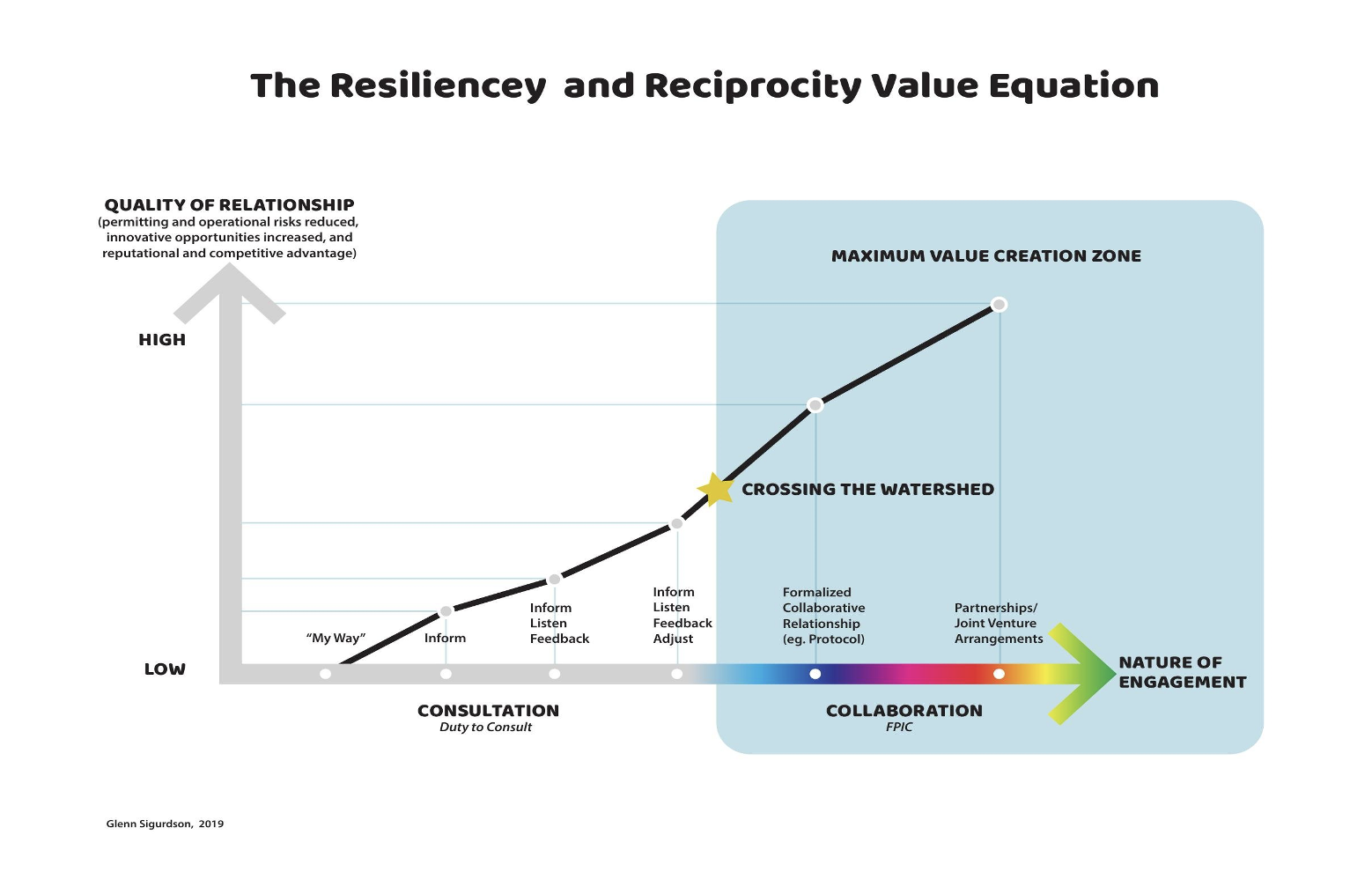
The art of how is knowing the implications of the choices you make in terms of the relationships you will build.
Building the Way: Relationships as Assets
The art of how is not about arriving with a structure. It is about building one — piece by piece, through the process, with the parties who will have to live with what gets built. That distinction matters. A relationship that has been designed from the outside and handed to a community is brittle. A relationship that has been constructed together, through genuine engagement, negotiation, and shared problem-solving, is durable. People live out what they helped build. They are far less likely to live out what was imposed on them, however skillfully.
This building process has two dimensions that must be held together. Internally, it requires alignment across functions — shared understanding of what the organization is trying to achieve and how decisions in one part of the organization affect relationships in another. Externally, it requires the construction of genuine working relationships with communities, Indigenous nations, and regions — relationships built on clear expectations, honest communication, and agreed-upon ways of handling the differences and difficulties that will inevitably arise. Neither dimension is sufficient without the other. Internal alignment without external relationship produces efficiency in the wrong direction. External engagement without internal alignment produces promises that cannot be kept.
If sustainability is to function as a strategic lens rather than a reporting obligation, it cannot sit within a single function or department. It must be owned across the organization. Without that shared ownership, the level of integration required to align internal decisions with external outcomes cannot be achieved. The Granger Mine story illustrates exactly what happens when it isn’t.
The person who sets the clock drives the agenda. In most organizations, that person — the procurement officer whose commercial agreement determines the project timeline, the finance executive whose quarterly commitment shapes every downstream decision — is the last person in the room when the community relationship is discussed. Until that changes, the gap between what organizations intend and what they deliver will persist.
Currencies of Value
At the centre of this interaction is a further reality: the parties involved operate with different currencies of value. Companies, communities, Indigenous nations, governments, and others do not measure success in the same way. Economic return, environmental stewardship, cultural continuity, social well-being, and political accountability represent distinct but overlapping value systems.
The challenge is not to reduce these to a single metric, but to understand them and work across them. The task is to identify where value can be created across these different currencies — and how risks can be managed to sustain alignment over time. This is not a soft proposition. It is the strategic core of what resilient relationships and durable projects actually require.
Water is the clearest example of where these currencies converge. The old canary in the mine shaft was the early warning system for the underground environment: if it didn’t return, the air was unsafe. Water is now the primary environmental vector in mining — and fish play the same role the canary once did. They are the living indicator of whether the water is safe. The communities living on that water have been watching the fish long before any monitoring instrument picks up the signal — noticing what no baseline study has captured, carrying knowledge that no technical assessment has fully integrated. As water use is reduced and water relationships with communities improve, conflict and risk decrease while opportunity increases. Social innovation and technological innovation are not parallel tracks. They are the same track.
The Way Is the Outcome
In this sense, the outcome is not a fixed set of results, but the ability to sustain resilient relationships and structures over time. Organizational resilience and adaptability — not static results — are the true measures of success. As contexts evolve, outcomes will shift accordingly. What endures is the capacity to work together in an integrated, aligned way.
The real asset is the quality of the relationships and structures that have been built: their adaptability, their communication channels, their conflict resolution capabilities. In this context, the way is not just a means to an end — it becomes the outcome itself. How you begin largely determines where you end. A good way to a good place.
The practical payoff is not only a faster and more stable development process — though it is that. It is an operational period that runs on a different foundation. When mine, community, and region have built the way together, the symbiosis that follows is not a managed outcome. It is a lived one. People honour what they helped create. That is the art of how — disciplined, pragmatic, and ultimately the most direct route to the durable results the industry is looking for.
Mining the Past
These observations are not new. They reflect a trajectory of concentrated work that began with the World Commission on Environment and Development in 1987 — the Brundtland Commission — which introduced not only a three-part framing of society, economy, and environment, but more importantly a different way of thinking about decision-making: these dimensions considered together, concurrently, rather than sequentially or in isolation. That shift in thinking set in motion a sequence of practical work that would carry the argument forward for the next two decades.
In Canada, the trajectory ran through the National Round Tables on the Environment and the Economy, the development of Building Consensus for a Sustainable Future: Guiding Principles (1993), and the Whitehorse Mining Leadership Accord (1994). From there the line ran directly to Lima — to the 1998 workshop that brought the Latin American mining sector into this conversation for the first time — and then forward into the Global Mining Initiative and the Mining, Minerals and Sustainable Development project (1999–2002), directed by Luke Danielson, which produced Breaking New Ground — a landmark examination of the industry’s relationship with the world in which it operates.
That Lima workshop in 1998 asked a question that the Congress in 2026 is still asking: how do we build a sustainable future for this industry — one that creates genuine value for the communities and regions in which it works, not just for the companies that extract? It was not a question that arrived without history. It had been shaped by the Round Tables, tested in the Whitehorse process, and brought to Lima as part of a deliberate effort to extend the conversation beyond its northern origins. The answer that emerged then, and that remains the answer now, was relational and architectural: build the processes that fit the problems, invest in the relationships before they are needed, and recognize that the way decisions are made is as consequential as the decisions themselves.
What Happened — And What Didn’t
In revisiting this history through the podcast series Troubles to Transformation, developed with Luke Danielson in collaboration with Satarla and the Colorado School of Mines, a sobering pattern emerges. There has not been a fundamental shift away from process-oriented, systems-based thinking in the way the industry operates. The underlying organizational structures of large resource companies have remained largely unchanged — designed for linear execution, functional specialization, and control.
The growing emphasis on metrics, targets, and reporting frameworks is consistent with this structure. These tools have value, but they reflect and reinforce a linear, siloed approach that is poorly suited to managing complex, integrated challenges. ESG has added sophistication to the reporting without changing the underlying architecture. As a result, the same fractures keep opening — in different projects, in different jurisdictions, at different scales — because the structural conditions that produce them have not been addressed.
This paper is the sixth in the Drilling Up dispatch series, which has examined these themes across five previous dispatches: internal-external alignment, the role of structured relationships, the ESG framework and its limits, the Juukan Gorge case, and the implications of the critical minerals moment. The argument here is not to discard what has been built, but to reconnect with it — to mine the past, recovering insights that remain directly relevant to the challenges we now face.
Conclusion: The Real Constraint
The pressures associated with critical minerals will continue to intensify. The temptation to prioritize speed over process will grow. Yet the fundamental constraint is not technical or geological. It lies in our ability to align internally and engage externally in a coherent and disciplined way.
The future of the mining sector will not be determined solely by our ability to extract resources, but by our ability to align people — inside organizations and between organizations and the communities and regions in which they work. The art of how is not a soft discipline. It is the strategic core of whether projects proceed or fail, whether relationships endure or fracture, whether the industry earns the right to operate or spends its energy defending the right it claims.
We were in Lima before. The questions planted in 1998 grew into frameworks and initiatives that shaped a generation of practice. Some took root. Others did not. What we know now that we did not fully know then is that the structural problem is inside as much as outside — and that until organizations are built to hold the complexity they face, the gap between intention and outcome will persist.
If we begin well — grounded in alignment, relationships, and sound processes — we increase the likelihood of achieving durable, widely supported outcomes. If we do not, no amount of acceleration will compensate for the consequences.
A good way to a good place. That remains the challenge. And the opportunity.
Glenn Sigurdson, C.M., K.C.
glennsigurdson.com
April 2026
Keynotes: critical minerals; sustainability strategy; organizational alignment; Indigenous rights; ESG; stakeholder engagement; process design; social license.
Notes
- Mining, Minerals and Sustainable Development (MMSD) project (1999–2002), directed by Luke Danielson. See Breaking New Ground (2002); and Troubles to Transformation: Mining Dialogues, podcast series developed with Luke Danielson in collaboration with Satarla and the Colorado School of Mines.
- Helle Bank Jørgensen, Davos 2025, as cited in Dispatch 5: Critical Minerals + Critical Insights: Pivot to Strategy & Reboot ESG. glennsigurdson.com/dispatches. On the organizational culture dimension of sustainability — including the “who owns sustainability” question — see Dispatch 1: The Case for ESG+I. glennsigurdson.com/dispatches
- Dispatch 5: Critical Minerals + Critical Insights: Pivot to Strategy & Reboot ESG. glennsigurdson.com/dispatches
- Allen Edzerza, Indigenous Tahltan Elder, quoted and discussed in Dispatch 1: The Case for ESG+I. glennsigurdson.com/dispatches
- Dispatch 2: The Trojan Horse inside ESG: The Cracks Hidden Within the Organization. glennsigurdson.com/dispatches
- Professor Deanna Kemp, Centre for Social Responsibility in Mining, University of Queensland, and Professor Andrew Hopkins, Australian National University. “Corporate Dysfunction on Indigenous Affairs: Why Heads Rolled at Rio Tinto.” The Conversation, September 2020. As cited in Dispatch 2: The Trojan Horse inside ESG. glennsigurdson.com/dispatches
- The Granger Mine is a fictional composite inspired by real events, first introduced in Dispatch 3: The CEO’s Dilemma: The Cracks Inside Are On The Move, and analyzed in depth in Dispatch 4: The SEO Starts Digging. The quoted passage is from Dispatch 4. glennsigurdson.com/dispatches
- Dispatch 1: The Case for ESG+I, drawing on analysis developed across the Drilling Up series. glennsigurdson.com/dispatches