The Art of How: Internal Alignment and External Relationships in the Critical Minerals Era
April 23, 2026
ABSTRACT
Mining projects struggle for many reasons — technical, engineering, financial and political. Yet one of the most consequential constraints is often overlooked: the path a project travels to reach an outcome. Geopolitical forces are now intensifying the pressure to discover, access and develop the critical minerals on which the world’s economies and technologies depend — compressing timelines and raising the stakes for getting the process right. This paper argues that the central constraint is not only technical or geological; it is organizational, relational and institutional.
There is an important history to draw from. In the 1990s, a sustained body of work — from Canada’s Round Tables on the Environment and the Economy, to the 1998 Lima workshop, to the Mining, Minerals and Sustainable Development project — addressed a practical question: not simply what sustainability means, but how to build it. Building Consensus for a Sustainable Future: Guiding Principles was developed through a national, multi-jurisdictional negotiation involving more than five hundred participants, informed by extensive practice in complex public dispute resolution. Their importance lies not only in the principles themselves, but in the fact that the process was built in their image.
This paper reconnects that body of practice to the critical minerals moment through the lens of what I have come to call The Art of How — the discipline of building clear expectations about how we are going to work together as the essential ingredient in achieving outcomes. It examines why sustainability is best understood as a strategy for working across environmental, social and economic currencies of value; why environmental assessment is best understood as an informing process embedded in inclusive and credible decision-making; and why the progression from consultation to consensus, consent and partnership requires structure, not rhetoric. It also considers the recognition that external fragmentation is mirrored inside organizations, where misalignment among functions can undermine commitments made on the ground. The World Mining Congress returns to Lima in 2026. The challenge is not to rediscover the importance of trust and dialogue, but to build the structures required to sustain them.
KEYWORDS
critical minerals; sustainable development; consensus; environmental assessment; social license; Indigenous relations; organizational alignment; Peru
1. GROUND ZERO: WHERE PROJECTS MEET PEOPLE
I have spent much of my working life in the space between — between people and organizations, between companies and communities, between the technical and the social and the institutional, in the resource sector across Canada and internationally. It is a space where complex projects collide with complex realities, where different world views meet, where people who attach value to fundamentally different things have to find a way to see each other in the picture they are creating together. My role has always been that of the outsider-inside: not embedded within any one organization or interest, but navigating the cracks between them — between mining corporations and communities, governments and Indigenous peoples, environmentalists and resource developers. It is in those cracks, where interests collide, overlap and often conflict, that the real work happens.
Over five decades of practice, I have come to describe this body of work as The Art of How — working with the parties to understand what each attaches value to, and finding a way to bring those elements together in a creative exercise so that everyone can see themselves in the picture they are building together. The more the parties own the way, the more committed they will be to delivering the outcome. My role is to lead without owning — because if I own it, they don’t. And if they don’t own it, it doesn’t get done.
Mining projects struggle for many reasons — technical, engineering, financial, regulatory and political. Yet in the preoccupation with managing those variables, one of the most consequential is often overlooked: the path a project travels to reach an outcome. That path is where projects meet people. It is where risk is managed, value is created or lost, relationships are built or damaged, and decisions either hold or unravel.
The pressure to move faster is real. Geopolitical forces are intensifying that pressure — compressing the time available to discover, access and develop the critical minerals on which the economies and technologies of the world we have built now depend. But speed without a credible way of making decisions can defeat itself. It can compress the very relationships, information flows and trust conditions on which durable development depends.
There is an important history to draw from. In June 1998, seventy-six participants from eleven Latin American countries gathered in Lima to ask how mining could contribute to balanced, harmonious and sustainable development. Industry, governments, communities, Indigenous peoples, research institutions, NGOs and multilateral organizations were in the room. The question was not abstract. It was whether a depleting resource could still leave a sustainable legacy if the value generated by extraction was converted into durable economic, environmental, social and institutional outcomes.
That gathering was part of a broader arc: the World Commission on Environment and Development, Canada’s Round Tables on the Environment and the Economy, the Whitehorse Mining Leadership Accord, the Lima workshop, and then the global Mining, Minerals and Sustainable Development (MMSD) project. The World Mining Congress now returns to Lima. The questions have not disappeared. The stakes are higher.
2. SUSTAINABILITY AS STRATEGY, NOT A REPORTING CATEGORY
When Gro Harlem Brundtland introduced sustainable development to the world in 1987, she was careful to insist that ‘the environment does not exist as a sphere separate from human actions, ambitions, and needs.’ She understood that the heartbeat of sustainability is human behaviour. The definition she offered — development that meets the needs of the present without compromising the ability of future generations to meet their own needs — challenged the world to embrace a new way of thinking, being and acting, and to find resolutions for conflicts in values, interest and power. It spoke to questions of conduct and culture. In the decades since, we have struggled to hold onto that essence.¹
The original force of sustainability was strategic. It was not simply a desired state, a reporting system or an environmental label. It was a way of making decisions in circumstances where environmental, social and economic considerations must be held together rather than sequenced or traded off after the fact.
Those three streams do not exist in the abstract. On any watershed, in any region and around any mine, they are personified by people and institutions: communities, Indigenous nations, local governments, regulators, employees, investors, suppliers, environmental organizations and companies. Each operates with different currencies of value. For one party, value may mean return on capital. For another, cultural continuity, water security, employment, local procurement, political accountability, environmental stewardship or intergenerational well-being.
The strategic challenge is not to reduce these currencies to a single metric. It is to build outcomes across them. Sustainability hits the ground when those different value systems must be translated into a decision that people can live with and help implement. In that sense, sustainability is not an adjunct to strategy. It is strategy: the discipline of constructing decisions that can hold technically, socially, environmentally, politically and over time.
As sustainability became translated into ESG frameworks, much was gained in transparency and discipline. But something was also lost. Metrics began to overtake meaning. Reporting frameworks can show what has happened; they do not by themselves provide the navigation system for deciding what should happen next, with whom, and through what process. The issue is not whether metrics matter. They do. The issue is whether they serve the strategy or replace it.
Sustainability ultimately lives or dies through culture. In complex organizations, no ESG framework or reporting structure can consistently deliver resilient outcomes unless sustainability is embedded — up and down and across the organization — as a shared way of thinking and acting. At the same time, the influence of Indigenous peoples has grown dramatically through evolving legal rights, political realities, and rising global expectations around reconciliation, consent, and stewardship. Indigenous worldviews often approach sustainability not as a checklist of metrics, but as a holistic understanding of relationships — between people, communities, economies, and the natural world, across generations. A simple test cuts through all of it: ask who owns sustainability. If the answer is not everyone, the organization still has work to do.
3. GO SLOW TO GO FAST
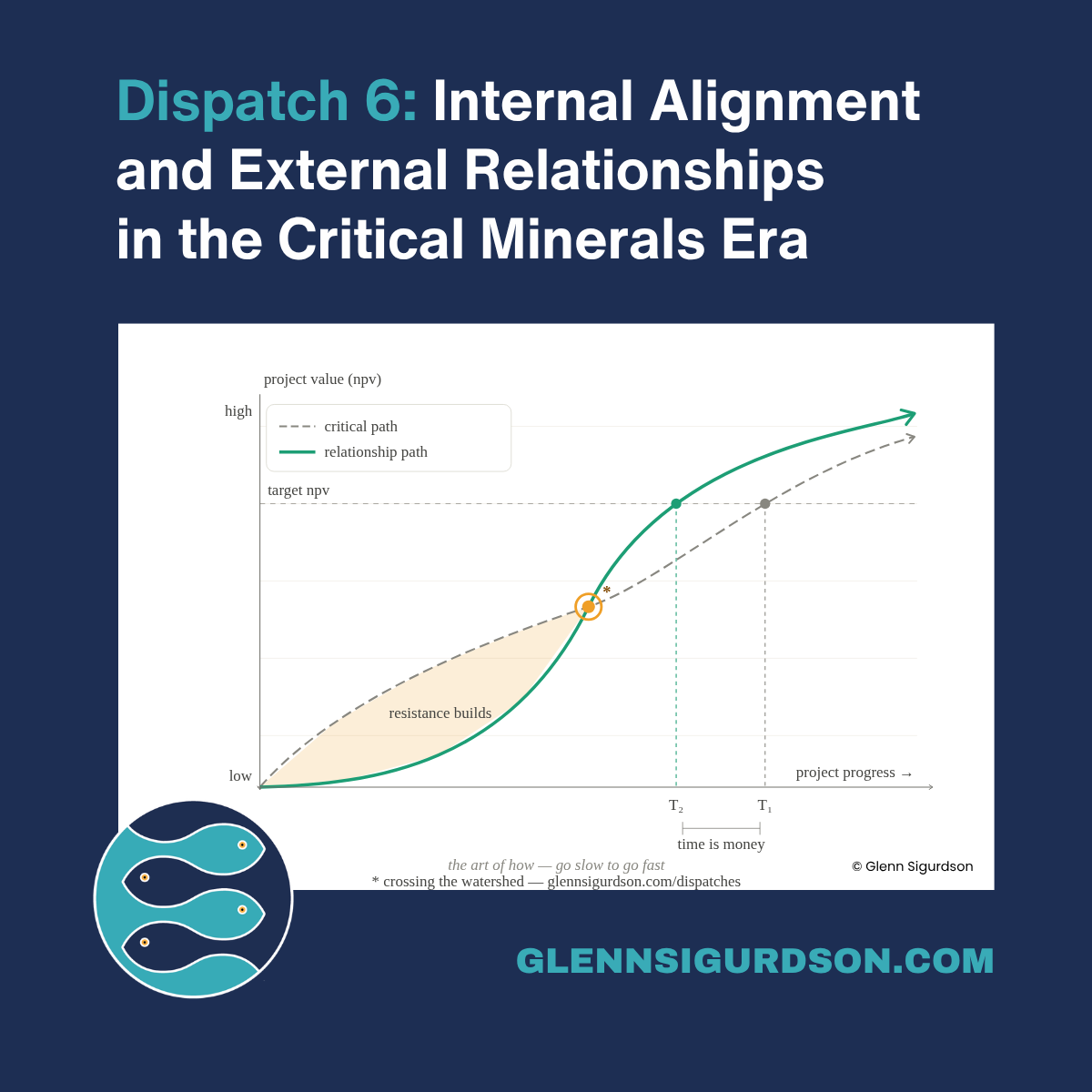
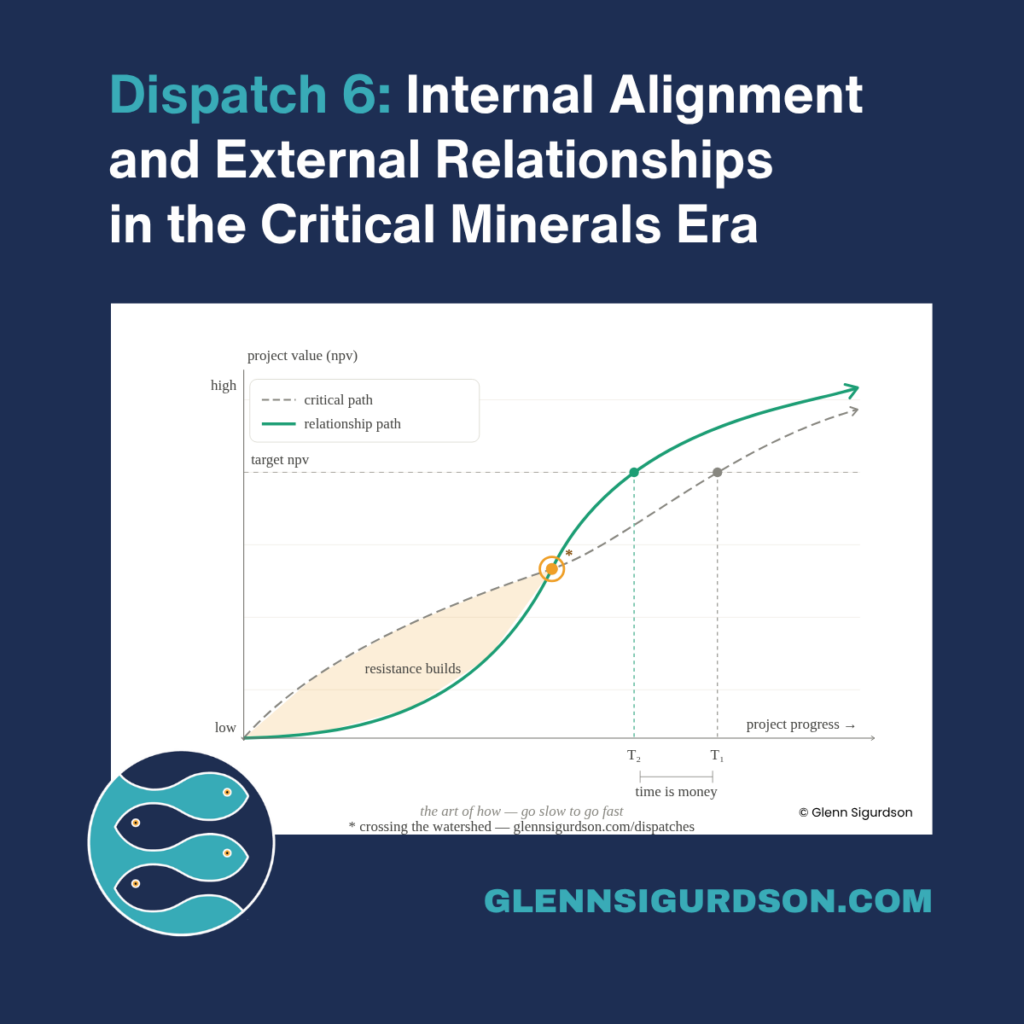
In a sector now under intense pressure to accelerate, understanding what speed actually depends upon becomes the critical question. The conventional model is the critical path: linear, sequential and time-driven. In that model, early relationship work can look like delay. Every week spent at the front end appears to be a week added to the schedule. But that model is incomplete. In project settings where communities, Indigenous nations and local regions carry the consequences of development, relationship work is not outside the critical path. It is part of it.
Through practice, I have come to describe the alternative as ‘go slow to go fast’ — a term of art I use consistently across this body of work, and one that the graphic below gives visual truth to. It is not a counsel of delay. It is a different and more accurate understanding of project arithmetic.
When early engagement is compressed, friction accumulates. It may begin with dust on a road, water concerns, employment expectations or distrust about information. If unaddressed, it becomes resistance, then conflict, then delay. Conversely, time invested early can change the shape of the project trajectory. Relationships are in place before they are tested. Information channels exist before they are needed. When difficult moments arise, there is something to hold.
The front end of a project is not dead time if it prevents the back end from becoming crisis time.

Figure 1 — Project trajectory comparison: linear critical path versus relationship-informed pathway (“go slow to go fast”)
Time is money. But time is also trust. And how you manage both determines your trajectory. The paradox is simple: push for speed at the beginning, and you often pay for it later in loss of trust. Invest early in alignment, and momentum builds when it matters most. In a world where the pressure to deliver critical minerals has never been greater, this is not a soft issue. It is a strategic one. The question isn’t whether you have a relationship path. You do. The question is whether you are managing both sides of it — internal and external — with the same discipline as your critical path.
4. THE GUIDING PRINCIPLES: BUILT, NOT DECLARED
Building Consensus for a Sustainable Future: Guiding Principles (Canadian Round Tables on the Environment and the Economy, 1993) — referred to throughout this paper as the Guiding Principles — were significant not only because of what they said, but because of how they were developed. They were not drafted by a small expert group and then offered to the field. They emerged through a national negotiation across Canada’s Round Tables on the Environment and the Economy, operating under the leadership of the National Round Table and involving provincial and territorial round tables across the country.
The process was multi-jurisdictional, multi-sectoral and demanding. More than five hundred people contributed: industry, governments, Indigenous representatives, labour, environmental organizations, communities and others. They brought different interests, mandates, vocabularies and forms of authority. The work required people to negotiate not only language, but meaning. The resulting principles had credibility because they were built by the kinds of people who would have to use them.
The process was also informed by a substantial body of practice in structuring and mediating complex public disputes. Years of work in large-scale environmental and resource conflicts, and years of training practitioners at the Banff Centre, provided practical knowledge about how multi-party processes succeed or fail. That experience did not substitute for the negotiation. It informed it. It helped ensure that the principles were not aspirational statements detached from practice, but operational tools grounded in what complex disputes actually require.²
The most important point is this: the process was built in the image of the principles. It was inclusive, informed, voluntary, self-designed, flexible and accountable. Participants were not simply consulted about a framework. They participated in constructing it. That is why the Guiding Principles carried authenticity. They expressed a way of working that had already been demonstrated in the way they were made.
One principle is especially important for the argument of this paper: equal opportunity and equal access to relevant information. In complex public decisions, participation without information is symbolic. Informed participation is not an accessory to decision-making; it is a condition of it.
5. FROM CONSULTATION TO CONSENSUS TO PARTNERSHIP
The distinction between consultation and consensus is not semantic. It goes to the distribution of influence and responsibility in decision-making.
Consultation informs decision-makers who retain authority. It may be necessary, and when done well it can improve understanding and reduce risk. But consultation does not, by itself, build a decision with the parties who must live with it. Consensus-based processes do something different. They engage participants in constructing the outcome. Consensus is not unanimity; it is a condition in which participants can live with the total package and support its implementation. That understanding is drawn directly from the Guiding Principles, and is set out in full in the Appendix to this paper.³
This distinction is central to the progression from consultation to collaboration, consensus, consent and partnership. Each step changes the relationship to power. Consultation expands voice. Collaboration creates joint work. Consensus seeks agreement on an implementable package. Consent introduces a stronger requirement of acceptance, particularly in Indigenous rights contexts. Partnership embeds shared responsibility, and in some cases shared ownership, into the structure itself.
Of all the dimensions of this progression, it is the Indigenous dimension that has risen most sharply. The expectations have changed fundamentally — not merely for consultation or even collaboration, but for genuine partnership, shared ownership, and relationships built to last. This is not a temporary pressure. It reflects a permanent shift in rights, law, and the moral expectations of the world in which the industry now operates.
The Round Tables work was therefore not merely an early consultation framework. It was an early and systematic effort to build collaborative, agreement-seeking processes that produced outcomes. The processes developed in Canada and demonstrated in Lima in 1998 were early expressions of what is now described in many places as partnership practice. They showed that the way a process is designed can move parties from being sources of input to being builders of outcomes — which is precisely what The Art of How is about.

Figure 2 — The Resiliency and Reciprocity Value Equation: progression from consultation toward collaboration, consensus, consent and partnership
6. LIMA, PERU AND THE CONTINUITY OF DIALOGUE
The Lima workshop in 1998 demonstrated that these ideas were not confined to Canada. The gathering was built in the image of dialogue — structured, inclusive, participant-driven. The facilitation was led by Antonio Bernales and Juan Arcos, Peruvian mediators and dialogue practitioners who created the conditions in which seventy-six people from eleven Latin American countries could build a shared vision and strategic objectives in real time. The process did not impose a Northern framework. It allowed the room to construct its own direction.
My contribution was to complement that facilitation by introducing the Guiding Principles — sharing a framework that had been built through the same kind of process the room was already experiencing. What gave the principles their moral authority, unlike expert-developed frameworks, was precisely this: they had been built and negotiated by the kinds of people who would have to use them, in exactly the spirit the principles themselves describe. When they were introduced in Lima, they landed because the room was already working in their image.
The significance of Lima is therefore not only historical. It was a proof of practice: inclusive, informed, structured dialogue across sectors and jurisdictions. It showed how a sustainability conversation could be made concrete by putting the people who carried the different currencies of value into a process designed to help them work across those differences.
The longer Peruvian story matters. The Grupo de Diálogo, Minería y Desarrollo Sostenible has sustained a voluntary multi-stakeholder dialogue in Peru for more than two decades. Its current description presents it as a multi-actor dialogue collective with twenty-five years of operation, promoting intercultural dialogue spaces and agendas around mining and sustainable development. The point is not to claim that the Grupo follows the Canadian principles exactly. It is to recognize the continuity of spirit: a durable commitment to dialogue-based approaches in a country where mining, development and social conflict have long been intertwined.
Antonio Bernales went on to found Futuro Sostenible, dedicated to environmental negotiation, consensus building and mediation, and has worked internationally, including through collaboration in GEMM-related work. His contribution reflects a sustained commitment to building practical, structured approaches to managing complex resource issues across sectors and interests.
That continuity has contemporary significance. In March 2026, Canada and Peru signed a Memorandum of Understanding to advance cooperation on critical minerals and sustainable mining. The agreement identifies investment, traceability, decarbonization, regulatory and governance frameworks, environmental and social best practices, and workforce development as areas of cooperation. That language is not only technical or commercial. It reflects a broader recognition that critical minerals development depends on governance, standards, social credibility and institutional capacity.
7. ENVIRONMENTAL ASSESSMENT: AN INFORMING PROCESS
Environmental assessment is often treated as a technical exercise: experts generate information, regulators review it, and decision-makers use it. That description is incomplete. Assessment is best understood as an informing process in decision-making — a way of developing, testing, sharing and using information in decisions that must hold across different interests, values and authorities.
This is where assessment lives inside the Guiding Principles. Inclusivity, informed participation, equal access to relevant information, respect for diverse interests and accountability are not procedural ornaments. They are the conditions that allow assessment information to have credibility. When assessment is built within an inclusive framework, it gains a voice of authority beyond expert assertion. It becomes part of a shared understanding of the problem and of the choices available.
Conversely, when assessment is expert-driven and isolated from the people who carry the consequences of the decision, its technical quality may not be enough. The science may be sound, but the process can still lack legitimacy. Credibility in assessment is not only a function of data. It is a function of process.
This perspective was reinforced in subsequent work in Peru. In 2013, Dr. Diana Arbeález-Ruiz, then with the Centre for Social Responsibility in Mining at the University of Queensland, led work examining dialogue, conflict and regulatory processes in environmental impact studies for mining projects. I was invited to contribute to that work, focusing on environmental assessment as an informing process in decision-making. Her work emphasized that assessment is not a neutral technical exercise floating above social reality, but an institutional process shaped by how participation is structured and how information is generated, shared and trusted.
In that Peruvian conversation, the continuity of earlier work became visible. A participant who would later be associated with leadership in the Peruvian dialogue community recognized the link to the earlier dialogue principles introduced years before. The importance of that moment was not personal attribution. It was recognition that the same underlying structure — inclusive, informed, structured engagement — was still relevant to how assessment processes could function in practice.
Assessment, then, is not a separate technical step beside the principles. It operates within them. Without that foundation, assessment may inform a decision. With it, assessment can help build a decision that holds.
8. THE INTERNAL MIRROR
The early sustainability and consensus work focused primarily on external complexity: companies, communities, governments, Indigenous peoples, environmental interests and others working across divides. Over time, another dimension became unavoidable. The same fragmentation seen externally is often mirrored internally inside organizations.
Large resource companies are organized through specialized functions: operations, procurement, finance, legal, external affairs, sustainability, permitting and executive leadership. Each function may pursue legitimate objectives. The problem arises when those objectives are not integrated. A procurement decision made for cost efficiency can undermine a community agreement. A production schedule can override commitments made through engagement. Legal compliance can be mistaken for social acceptance.
This is not usually a problem of bad intent. It is a problem of structure. The organization is not always structured to hold the integrated complexity of the environment in which it operates. External commitments are made in one part of the organization while internal decisions elsewhere alter the conditions on which those commitments depend.
The destruction of Juukan Gorge in Western Australia remains the starkest example. The blast was legally authorized, but critical information about cultural significance did not reach the operational decision point in a way that changed the outcome. The failure was not merely external engagement. It was internal integration. Information, authority and accountability did not connect. This organizational diagnosis has been examined with particular authority by Professor Deanna Kemp and Professor Andrew Hopkins of the Sustainable Minerals Institute at the University of Queensland. Their analysis cuts to the structural core: Rio Tinto was siloed, its segmented organizational structure leaving the corporation vulnerable to decisions by any one product division with disastrous human, environmental and reputational consequences for the whole.⁵
The same diagnosis plays out daily at the operational level, often with less visibility but no less consequence. I introduced a fictional composite case — the Granger Mine — in Dispatch 3 of the Drilling Up series to illustrate precisely how an internal misalignment, in this case a global procurement mandate that overrode a community fuel supply agreement, can unravel months of carefully built trust.⁴ The case shows that there is no villain, no single bad decision — only a structure never designed to hold the integrated complexity of the world in which it now operates.
This is where internal-external alignment enters the paper. It is not the whole argument, and it should not eclipse sustainability, consensus or assessment. It is a downstream recognition from years of practice: the best external process can be undercut if the organization carrying it is not aligned internally. To work outside, organizations must also work inside.
9. SUSTAINABLE RELATIONSHIPS FOR SUSTAINABLE OUTCOMES
The concept of social license to operate, introduced by Jim Cooney in the late 1990s, helped the mining sector name a central challenge: the relationship between mining and society. It captured the growing reality that legal permission alone does not settle the question of whether a project can proceed in a stable and legitimate way. Cooney’s later recognition in the Canadian Mining Hall of Fame reflected the importance of that contribution. But naming the challenge does not resolve how to manage it.
The same is true of the growing recognition of Indigenous rights, consent and partnership. The language has moved quickly. Practice has moved unevenly. In Canada, particularly British Columbia, constitutional law, the United Nations Declaration on the Rights of Indigenous Peoples, and a substantial body of litigation have changed the practical balance of power. Mining companies are increasingly building partnership structures with First Nations. In Peru and across Latin America, mining has also generated dialogue platforms, conflict mechanisms and continuing efforts to connect development with social legitimacy.
In Canada, the Mining Association of Canada has also played a practical role through its Towards Sustainable Mining initiative and more recent efforts to align standards. Those efforts are not the same as the consensus work, but they reflect a continuing attempt to translate responsible mining commitments into structures that can be assessed and applied.
The issue is not whether consultation, consent or partnership are desirable words. The issue is whether the process structure exists to make them real. Partnership requires more than relationship language. It requires shared information, clear expectations, agreed ways of managing differences, mechanisms for implementation, and internal organizational structures capable of honoring what has been agreed.
In this sense, the old consensus work and the new partnership world are directly connected. The Guiding Principles represented an early and systematic effort to build agreement-seeking processes across differences. Partnership extends that logic into more durable institutional forms. Sustainable relationships are not an outcome of the project. They are the foundation on which sustainable outcomes depend.
10. MINING THE PAST TO BUILD THE FUTURE
The point of mining the past is not nostalgia. It is to recover what remains useful for the future. The Guiding Principles, Lima 1998, MMSD, the Peruvian dialogue experience, environmental assessment work and contemporary critical minerals cooperation all point to the same underlying lesson: durable development depends on the deliberate design of processes that can integrate across differences.
The industry does not lack language. It has sustainability, ESG, social license, consent, partnership, shared value, responsible mining and critical minerals strategy. The danger is that language can outrun practice. The practical question is whether the structures exist to carry the commitments those words imply.
Efforts such as the Global Energy, Minerals and Markets (GEMM) dialogues from 2011 to 2021 reflected the same continuing need: to sustain structured engagement across sectors, disciplines and jurisdictions when the issues are larger than any one organization can manage alone.
The contribution of this paper is to reconnect a body of practice to the present moment through the lens of The Art of How. The central challenge is not the invention of entirely new ideas. It is the institutionalization of what experience has already shown: that inclusive, informed, accountable and self-designed processes create better foundations for decisions; that assessment gains authority when it is embedded in such processes; that consensus differs from consultation because it builds outcomes rather than merely informing them; and that external commitments require internal alignment to endure.
Critical minerals have raised the urgency. They have not changed the underlying problem. The world needs minerals faster, smarter and more responsibly. That will not be achieved by speed alone. It will be achieved by better ways of deciding, better ways of building relationships, and better organizational structures to sustain both.
This oral history — tracing the trajectory of change across five decades — is the subject of Mining Dialogues: From Troubles to Transformation, a podcast series in which Luke Danielson and I serve as speakers and commentators, hosted by Priscilla Nelson of the Colorado School of Mines and Mónica Ospina, produced in collaboration with Satarla. It is part of the same body of work as the Drilling Up dispatch series — a name that reflects a career spent on the ground, pulling insights up from practice rather than down from theory. Both the dispatches and the podcast are available at glennsigurdson.com. The podcast is also available on Spotify and YouTube at satarla.com/mining-dialogues.
11. CONCLUSION: THE REAL CONSTRAINT
The fundamental constraint on responsible critical minerals development is not only technical or geological. It lies in the ability to align people, information, institutions and organizations around decisions that can hold.
The Art of How is the discipline of designing those processes. It is not soft. It is strategic. It determines whether information is trusted, whether communities see themselves in the decision, whether organizations can honor what they commit to, whether assessment becomes legitimate, and whether the project pathway accelerates or stalls.
We were in Lima before. The questions asked in 1998 are still with us, but they now sit inside a more urgent geopolitical and economic context. The recent Canada-Peru agreement on critical minerals and sustainable mining is a reminder that the technical, economic and institutional dimensions of mining cannot be separated.
The challenge is not to rediscover that dialogue, trust and sustainability matter. The challenge is to build the structures required to sustain them. A good way to a good place. The way you begin will determine where you end.
ACKNOWLEDGEMENTS
The author acknowledges the participants in the Canadian Round Tables process, the colleagues involved in the Lima 1998 workshop, and those in Peru and elsewhere who have sustained dialogue-based approaches in mining and sustainable development over many years. The author also acknowledges the contributions of Gerald Cormick, Antonio Bernales, Juan Arcos, Luke Danielson, Jim Cooney and Dr. Diana Arbeález-Ruiz to the bodies of practice and inquiry reflected in this paper.
REFERENCES
Sigurdson, G. (2021). Dispatch 1: The Case for ESG+I. Drilling Up series. glennsigurdson.com/dispatches. The Brundtland passage is drawn from this dispatch, which develops the argument that the heartbeat of sustainability is human behaviour and that Brundtland’s original framing spoke to questions of conduct and culture.
Gerald W. Cormick’s article, ‘Strategic Issues in Structuring Multi-Party Public Policy Negotiations’ (Negotiation Journal, 1989), and related environmental mediation practice formed part of the practical background that informed the Round Tables process. The point is not attribution to individual practitioners, but the grounding of the Guiding Principles in an established body of multi-party public dispute experience.
The definition of consensus and the full text of the ten Guiding Principles, in English and Spanish, are set out in the Appendix to this paper, with a note on sources.
Sigurdson, G. (2024). Dispatch 3: The CEO’s Dilemma — The Cracks Inside Are On The Move. Drilling Up series. glennsigurdson.com/dispatches. The Granger Mine is a fictional composite grounded in real events, first introduced in Dispatch 3 and developed further in Dispatch 4: The SEO Starts Digging.
Kemp, D., & Hopkins, A. (2020). Corporate dysfunction on Indigenous affairs: Why heads rolled at Rio Tinto. The Conversation. Kemp and Hopkins identify Rio Tinto’s siloed organizational structure as the root cause of the Juukan Gorge disaster — not malice or a single bad decision, but a segmented structure that left the corporation vulnerable to any one product division making decisions with consequences that threatened the social license of the whole. See also: Sigurdson, G. (2024). Dispatch 2: The Trojan Horse inside ESG — The Cracks Hidden Within the Organization. Drilling Up series. glennsigurdson.com/dispatches.
Arbeález-Ruiz, D. (2015). Dialogue, conflict and regulatory processes in environmental impact studies for mining projects. Centre for Social Responsibility in Mining, Sustainable Minerals Institute, University of Queensland.
—
Arbeález-Ruiz, D. (2015). Dialogue, conflict and regulatory processes in environmental impact studies for mining projects. Centre for Social Responsibility in Mining, Sustainable Minerals Institute, University of Queensland.
Cormick, G. W. (1989). Strategic issues in structuring multi-party public policy negotiations. Negotiation Journal, 5(2), 125–132.
Cormick, G., Dale, N., Emond, P., Sigurdson, G., & Stuart, B. (1996). Building consensus for a sustainable future: Turning principles into practice. Ottawa: National Round Table on the Environment and the Economy.
Danielson, L. (Ed.). (2002). Breaking new ground: Mining, minerals and sustainable development. Earthscan.
Grupo de Diálogo, Minería y Desarrollo Sostenible. (2026). Website description of GDMDS as a multi-actor dialogue collective promoting intercultural dialogue spaces and agendas.
Kemp, D., & Hopkins, A. (2020). Corporate dysfunction on Indigenous affairs: Why heads rolled at Rio Tinto. The Conversation.
National Round Table on the Environment and the Economy. (1993). Building consensus for a sustainable future: Guiding principles. Ottawa: NRTEE. Available at glennsigurdson.com.
Natural Resources Canada. (2026, March 18). Canada and Peru sign agreement to collaborate on mining. Government of Canada.
Nelson, P., Ospina, M., Sigurdson, G., & Danielson, L. (2024–2025). Mining Dialogues: From Troubles to Transformation. Podcast series hosted by Satarla and Colorado School of Mines. satarla.com/mining-dialogues.
Seymoar, N. K., Roca, C., & Lavergne, R. (1998). Lima workshop on mining and sustainable development in the Americas: Report of proceedings. IISD / IDRC.
Sigurdson, G. (1994). The Sandspit Harbor Mediation Process. Subsequently published in Alternative Dispute Resolution in Environmental Conflicts: Experiences in 12 Countries. Berlin: Edition Sigma, 1997.
Sigurdson, G. (1999). ADR in a resource and environmental context. Subsequently published in Interaction, Vol. 9, No. 4.
Sigurdson, G. (2021–2026). Drilling Up dispatch series. glennsigurdson.com/dispatches.
United Nations. (2007). United Nations Declaration on the Rights of Indigenous Peoples. United Nations.
APPENDIX
The Guiding Principles for Building Consensus
In Lima in June 1998, I presented the Guiding Principles to seventy-six people from eleven Latin American countries gathered to ask a foundational question: how do we build a sustainable future for mining and the communities in which it operates? The discussion that arose went directly to the heart of what this paper is about. The room drew a sharp distinction between consultation — where one group makes the decisions and asks others for input — and consensus, where each party at the table has an equal opportunity to influence the outcome.
Definition of Consensus
A consensus process is one in which all those who have a stake in the outcome aim to reach agreement on actions and outcomes that resolve or advance issues related to environmental, social, and economic sustainability. In a consensus process, participants work together to design a process that maximizes their ability to resolve their differences. Although they may not agree with all aspects of the agreement, consensus is reached if all participants are willing to live with “the total package.”
The Ten Principles
- Purpose-Driven — People need a reason to participate in the process. Impulsado por un propósito — La gente necesita una razón para participar en el proceso.
- Inclusive, Not Exclusive — All parties with a significant interest in the issues should be involved. Inclusivo, No Exclusivo — Todas las partes con un interés significativo en los temas deben estar involucradas en el proceso de consenso.
- Voluntary Participation — The parties who are affected or interested participate voluntarily. Participación voluntaria — Las partes que se ven afectadas o que están interesadas participan voluntariamente.
- Self-Design — The parties design the consensus process. Auto diseño — Las partes diseñan el proceso de consenso.
- Flexibility — Flexibility should be designed into the process. Flexibilidad — La flexibilidad debe incorporarse en el diseño del proceso.
- Equal Opportunity — All parties have equal access to relevant information and the opportunity to participate effectively throughout. Igual oportunidad — Todas las partes tienen igual acceso a la información relevante y la oportunidad de participar de manera efectiva durante todo el proceso.
- Respect for Diverse Interests — Acceptance of the diverse values, interests, and knowledge of the parties involved is essential. Exigencia de intereses diversos — Es esencial que haya aceptación de los diversos valores, intereses y conocimiento de las partes involucradas en el proceso de consenso.
- Accountability — The participants are accountable both to their constituencies and to the process they have agreed to establish. Responsabilidad — Los participantes son responsables tanto de su jurisdicción como del proceso que han acordado establecer.
- Time Limits — Realistic deadlines are necessary throughout the process. Límites de tiempo — Se necesitan plazos realistas durante todo el proceso.
- Implementation — Commitment to implementation and effective monitoring are essential parts of any agreement. Implementación — Los compromisos para la implementación y el monitoreo efectivo son partes esenciales de cualquier acuerdo.
Note: The definition of consensus and the ten Guiding Principles above are drawn directly from Building Consensus for a Sustainable Future: Guiding Principles (Canadian Round Tables on the Environment and the Economy, August 1993), available at glennsigurdson.com. Each principle is described and expanded upon in considerably greater detail in that document, and in the companion volume, Building Consensus for a Sustainable Future: Putting Principles into Practice (Cormick, Dale, Emond, Sigurdson and Stuart, National Round Table on the Environment and the Economy, 1996).